


Engineered Timber vs Solid Timber Flooring is one of the most important flooring comparisons Australian homeowners make in 2026. Both options use genuine hardwood. However, their internal structure, installation method, climate performance, and long-term value differ significantly.
Choosing the wrong timber flooring can lead to movement issues, moisture damage, or unnecessary long-term costs. Therefore, understanding construction technology, sanding capacity, and environmental suitability is essential before investing.
This in-depth guide provides a detailed comparison of engineered timber and solid timber flooring based on Australian climate conditions, installation practices, cost expectations, and resale value impact.
| Feature | Engineered Timber | Solid Timber |
|---|---|---|
| Composition | Hardwood veneer with multi-layer core | 100% solid hardwood plank |
| Structural Stability | High resistance to expansion | Natural expansion and contraction |
| Concrete Slab Installation | Suitable | Generally unsuitable |
| Apartment Friendly | Yes (floating system) | Often restricted |
| Refinishing Cycles | 1–3 times | 4–8+ times |
| Expected Lifespan | 20–40 years | 50–100+ years |
| Installed Cost (2026) | $130–$220 per m² | $180–$300+ per m² |
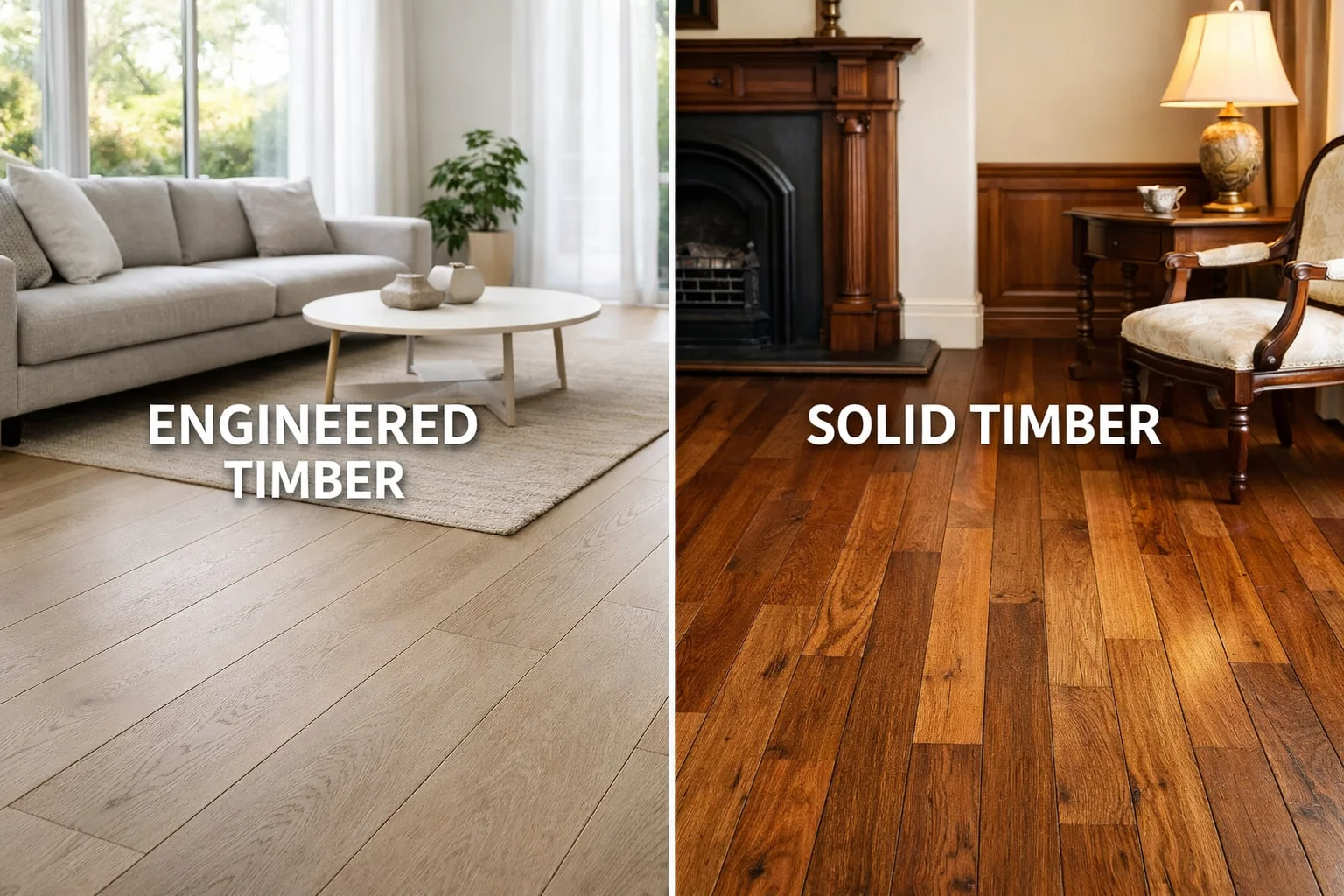
Engineered timber flooring consists of a genuine hardwood surface layer bonded to a cross-laminated core. The layered construction improves dimensional stability by limiting the natural movement of timber caused by humidity and temperature fluctuations.
Because the core layers run in opposing directions, engineered boards resist warping, cupping, and gapping more effectively than traditional solid timber.
Premium engineered boards now use high-density hardwood cores, reducing hollow sound in floating installations and increasing load-bearing strength.
Solid timber flooring is manufactured from a single piece of hardwood. Unlike engineered boards, it contains no internal layers. Because it is fully natural wood, it reacts directly to environmental changes.
In Australia, solid timber boards typically measure 19mm–22mm thick and are installed using a traditional nail-down method onto timber subfloors.
Solid timber remains a preferred option for architectural homes and long-term ownership properties.
In cities such as Sydney, Brisbane, and coastal areas, humidity levels fluctuate throughout the year. Engineered timber performs better in these conditions due to its layered core structure.
Solid timber expands during humid seasons and contracts in dry periods. Proper acclimatisation and moisture control are essential to prevent movement issues.
Modern Australian homes commonly use concrete slab foundations. Engineered timber can be installed directly over slabs using glue-down or floating systems. Solid timber typically requires a raised timber subfloor.
Engineered timber is ideal for apartments because it supports floating installations with acoustic underlay systems. Many strata buildings restrict solid timber installation due to noise and subfloor limitations.
Durability depends on timber species hardness. Australian hardwoods such as spotted gum, blackbutt, and ironbark provide strong resistance to dents and scratches.
Solid timber offers deeper sanding capacity. Engineered timber’s refinishing ability depends on veneer thickness.
Neither flooring type is waterproof. Both require proper moisture management.
| Cost Category | Engineered Timber | Solid Timber |
|---|---|---|
| Material Cost | $80–$160 per m² | $100–$200 per m² |
| Installation Cost | $50–$70 per m² | $80–$120+ per m² |
| Total Installed Cost | $130–$220 per m² | $180–$300+ per m² |
Solid timber costs more because it requires on-site sanding, sealing, and skilled labour.
Both flooring types enhance property appeal. Solid timber traditionally commands higher prestige due to its lifespan and refinishing capacity. However, premium engineered timber now competes closely in modern builds.
The correct decision depends on ownership duration, property type, and environmental exposure.
Yes. The top layer is genuine hardwood. The difference lies in the internal core construction.
Engineered timber generally performs better in fluctuating humidity conditions.
Yes. Most products allow 1–3 sanding cycles depending on veneer thickness.
Yes. Solid timber can exceed 50 years and be refinished multiple times.
It is a strong investment for long-term homeowners seeking durability and traditional appeal.
The Engineered Timber vs Solid Timber Flooring decision ultimately depends on climate exposure, subfloor structure, and long-term ownership plans. Both flooring systems use genuine hardwood, yet their internal construction leads to very different performance outcomes.
Engineered timber delivers superior dimensional stability, excellent compatibility with concrete slabs, and reliable performance in modern Australian homes. It is particularly suitable for apartments and properties exposed to humidity variations. You can explore premium engineered flooring collections to compare structural specifications and finish options.
On the other hand, solid timber provides unmatched lifespan, deeper refinishing potential, and traditional hardwood authenticity. For homeowners prioritising long-term durability and heritage appeal, solid timber remains a premium investment. Professional installation and craftsmanship are critical, and experienced suppliers such as Create Timber Floor can assist with expert guidance.
Ultimately, both flooring options add value and character to a property. The correct choice requires aligning performance characteristics with your structural conditions and future expectations. For broader timber flooring resources and product comparisons, you may also review industry suppliers such as OzWorld Flooring.
In conclusion, engineered timber is the practical modern solution for climate flexibility and slab construction, while solid timber remains the long-term craftsmanship choice for maximum lifespan and refinishing capacity.