







Herringbone vs Chevron flooring is one of the most important design decisions for homeowners and interior professionals in 2026. Although both patterns create a striking zigzag effect, they differ significantly in structure, installation precision, cost, visual impact, and spatial influence.
Because flooring is a long-term investment, choosing between herringbone and chevron should not be based on appearance alone. Instead, you must evaluate layout symmetry, subfloor conditions, installation expertise, and budget allocation. A well-informed decision ensures visual harmony and long-term performance.
This detailed guide explains the structural differences, installation process, cost comparison, performance expectations, and design suitability of both patterns so you can confidently select the right parquet style.
At first glance, both patterns look similar. However, their plank geometry creates a completely different visual rhythm.
Therefore, the primary distinction lies in board preparation and alignment accuracy. This difference directly affects labor intensity, waste percentage, and final cost.
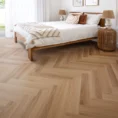
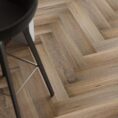
Herringbone is a classic parquet pattern that dates back centuries in European architecture. Its broken zigzag layout creates texture and movement while maintaining balance.
Because the boards are not pre-angled, installers have slightly more tolerance during placement. As a result, herringbone flooring is often more adaptable in rooms with irregular layouts or multiple corners.
In addition, the pattern works well in both heritage renovations and modern transitional interiors.
Chevron flooring delivers precision and architectural symmetry. Each plank is manufactured with angled ends, allowing them to meet perfectly in a sharp and continuous V formation.
Because alignment must remain exact from the first row to the last, even minor subfloor inconsistencies can disrupt the pattern. Consequently, chevron flooring demands a higher level of installer expertise.
Although both options are premium choices, they influence spatial perception differently.
| Design Aspect | Herringbone | Chevron |
|---|---|---|
| Pattern Flow | Broken zigzag | Continuous V direction |
| Spatial Effect | Adds texture and movement | Creates elongation and symmetry |
| Room Compatibility | Versatile across layouts | Best in symmetrical spaces |
| Visual Strength | Balanced and refined | Bold and architectural |
For example, chevron can visually lengthen narrow spaces due to its directional flow. Meanwhile, herringbone distributes visual weight more evenly across the floor.
Installation precision plays a major role in overall cost and timeline.
| Installation Factor | Herringbone Flooring | Chevron Flooring |
|---|---|---|
| Board Preparation | Rectangular planks | Factory-cut angled ends |
| Skill Level Required | Experienced installer | Specialist parquet installer |
| Installation Speed | Moderate | Slower due to precision alignment |
| Error Margin | More forgiving | Very low tolerance |
In practical terms, chevron flooring often takes longer to install. Furthermore, material wastage tends to be higher because angled cuts cannot always be reused.
While material selection influences pricing, the pattern itself also affects the overall budget.
| Cost Element | Herringbone | Chevron |
|---|---|---|
| Material Pricing | Mid-range | Premium |
| Labor Cost | Medium | High |
| Material Waste | Moderate | Higher due to angled cuts |
| Overall Budget | More accessible | Luxury-tier investment |
Therefore, if budget efficiency is a primary concern, herringbone often offers better cost control. However, for high-end architectural projects, chevron delivers stronger visual distinction.
Importantly, the pattern does not determine durability. Instead, durability depends on the material used, such as engineered timber or hybrid flooring.
Both patterns perform exceptionally well when manufactured under modern 2026 production standards. Proper installation and subfloor preparation are critical for long-term structural stability.
When evaluating Herringbone vs Chevron flooring, the right decision ultimately comes down to three key factors: spatial geometry, installation precision, and desired visual impact. Although both patterns belong to the premium parquet category, they create distinctly different atmospheres within a space.
Herringbone flooring offers flexibility, depth, and timeless character. Its staggered zigzag formation suits both classic and transitional interiors while remaining more forgiving during installation. This makes it ideal for homeowners seeking long-term design adaptability without excessive installation complexity.
Chevron flooring, on the other hand, delivers precision and architectural symmetry. Its continuous V-shaped flow creates direction and elegance, particularly in open-plan or luxury environments where clean alignment enhances the overall aesthetic statement.
Importantly, both patterns are available in modern engineered timber constructions that provide structural stability, durability, and long-term performance.
If you are considering high-quality engineered parquet options, you can explore premium selections through Engineered Herringbone Flooring by Artafloor,discover broader timber flooring solutions at OzWorld Timber Flooring, or review curated Australian collections via Preference Floors Australia.
Ultimately, whether you choose herringbone or chevron, both represent premium flooring investments in 2026. The best option aligns with your room proportions, architectural vision, budget allocation, and long-term property goals.
Generally, yes. Herringbone uses standard rectangular planks, which reduce manufacturing complexity and installation labor compared to chevron.
Yes. The continuous V pattern can visually elongate narrow spaces and create a directional flow that enhances perceived length.
Herringbone is typically easier because it does not require precise angled board cuts and strict central alignment.
Yes. Both herringbone and chevron are widely available in engineered timber, as well as hybrid and laminate options.
No. Maintenance depends on the surface finish and material, not the geometric pattern itself.
Both add value. However, chevron may appeal more strongly in luxury property markets, while herringbone has broader buyer appeal.